
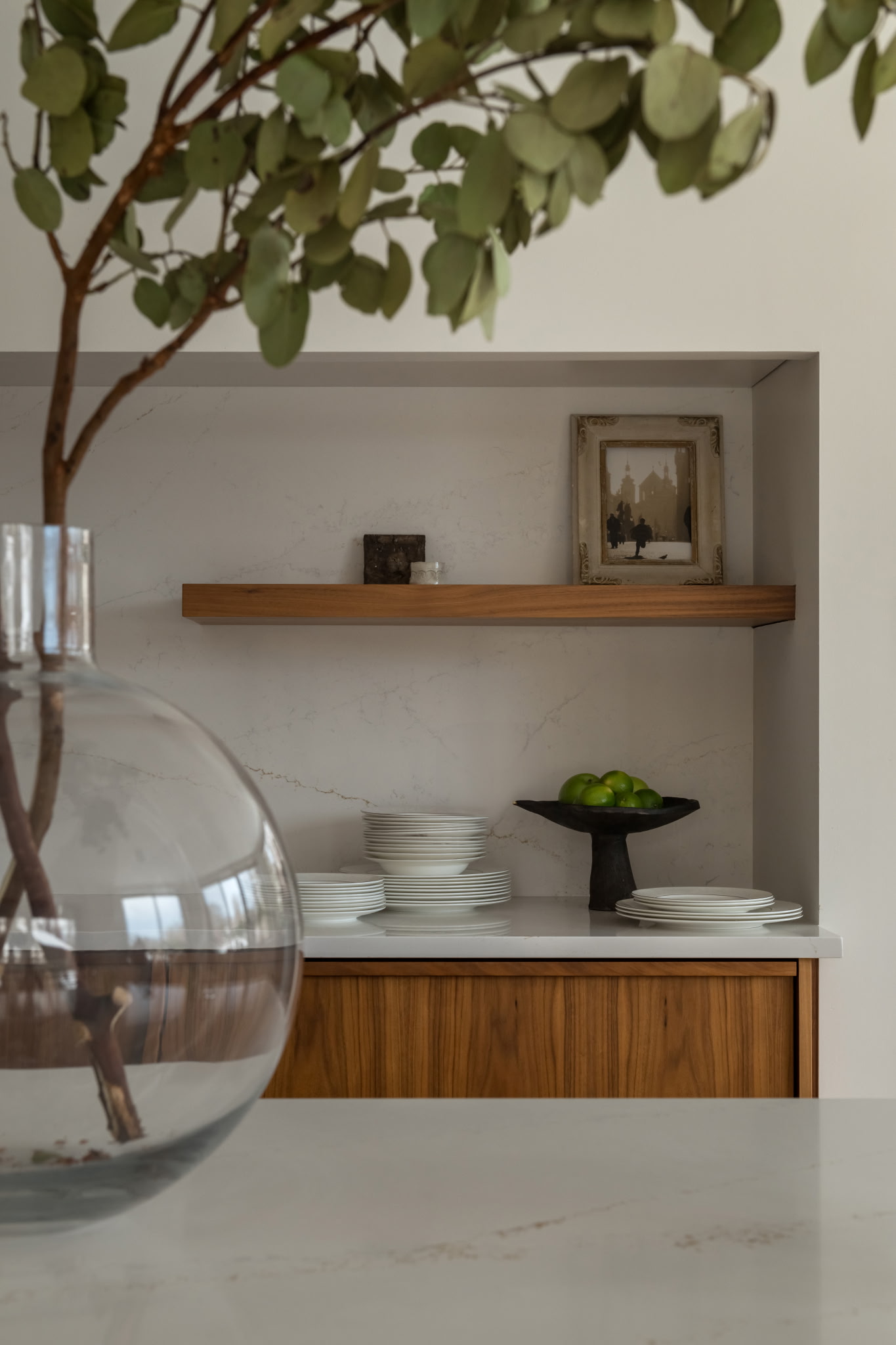
Clients often assume a "refresh" means new furniture or a repaint. Most of the time, it means neither. Roughly every three months, we walk a home with a short, unglamorous checklist — the same one below — and it's almost always enough to make a space feel current again without touching a single wall.
Swap what's in every vase
Dried branches and greenery are the single fastest way to shift a room's season. We rotate them quarterly at minimum — what reads as fresh in October reads as tired by January. If nothing else on this list gets done, this alone changes a room more than people expect.
Rotate textiles before you rotate furniture
Throws, table linens, and cushion covers are the cheapest, lowest-risk way to shift a room's temperature — literally and visually. Heavier weaves and warmer tones for colder months, linen and lighter tones as the light changes. None of this requires new furniture underneath.
Edit the surfaces down, then add one new thing
Every quarter, surfaces accumulate — mail, mugs, things that landed and never left. Before adding anything seasonal, we clear each surface back down to its actual styled state, then add just one new object: a bowl of in-season fruit, a single new ceramic, a candle in a new scent. Editing first is what makes the addition feel intentional instead of extra.
Check the same niches and shelves every time
The small, framed moments in a home — a bathroom niche, an open kitchen shelf, an entry console — are worth checking every season specifically, because they're high-visibility and low-effort to update. These are usually the first places we touch on a refresh visit, and often the only places that actually need it.
Walk it at the time of day people actually use it
A living room refresh should be reviewed in evening light if that's when it's used most; a kitchen in the morning. We always do a final walkthrough at the room's real "peak hour" before calling a refresh finished — styling that only works in staged daylight isn't finished yet.
This entire checklist is designed to be done in an afternoon, a few times a year, without a designer, a contractor, or a big-box run — though it's exactly what we walk through with clients who'd rather hand it off entirely.