
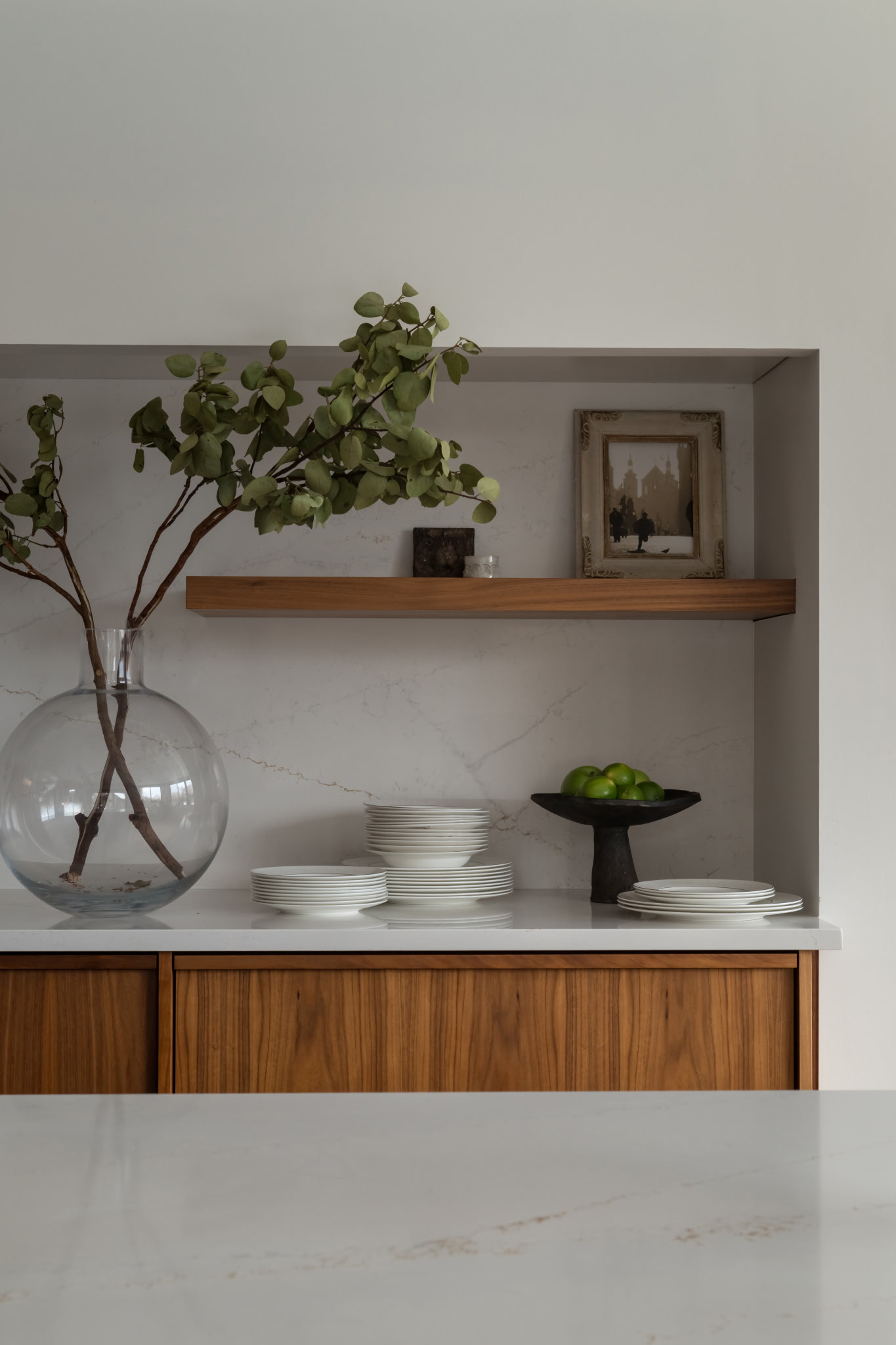
Open shelving is one of the first things a client asks us to help with — and one of the easiest to get wrong. Done well, it looks like the natural, gathered-over-time result of a life well lived. Done poorly, it reads as clutter with better lighting. The difference usually comes down to a handful of habits, not a bigger budget.
1. Group in odd numbers
Threes and fives read as intentional in a way that pairs rarely do. When we style a shelf, we build in small clusters — a stack of bowls, a single vase, one small object with texture — rather than lining items up evenly across the whole run. Odd-numbered groupings give the eye a natural resting point instead of a row to scan.
2. Let height do the work
A shelf full of objects at the same height goes flat immediately. We anchor each grouping with one taller piece — a vase, a pitcher, a framed print — and let everything else step down from there. It's the same principle as a good bookshelf: variation in height creates rhythm, and rhythm is what makes a shelf feel curated rather than cataloged.
3. Repeat one material, twice
Stacked white dinnerware, a dark ceramic bowl, a walnut cutting board — the shelves that feel most cohesive usually repeat two or three materials across the whole vignette rather than introducing something new in every grouping. It's a small discipline, but it's the fastest way to make a shelf look like it belongs to one home instead of several different shopping trips.
4. Leave a third of it empty
This is the rule clients push back on most, and the one that matters most. A shelf styled to capacity photographs busy and lives worse — you lose the actual storage function you built the shelving for in the first place. We aim for roughly a third of visible shelf space left open, usually toward one end, so the eye has somewhere to land.
5. Style for the light you actually have
Glass and pale ceramics glow beautifully under direct light and disappear in a dim corner. Before we finalize a shelf, we check it at the time of day it'll actually be seen most — morning coffee, evening dinner prep — and adjust materials accordingly. A shelf that looks perfect in a midday photo but invisible at 7pm isn't really finished.
None of this requires new furniture or a full renovation — just a slower, more deliberate pass over what's already in the house, and a willingness to put some of it away. That's usually where the actual styling happens.